Koala AI vs Autoblogging.ai for Bulk Content Automation
You are choosing between two bulk content tools and need a straight answer. One promises hundreds of articles from a single CSV upload; the other caps out far sooner. Picking wrong means paying per article or rebuilding your publishing workflow.
This comparison covers what Autoblogging.ai and Koala AI each do, how their bulk generation limits, SERP analysis, integrations, and pricing stack up, and which tool fits bloggers, agencies, and WordPress publishers. By the end you will know which one to buy.
Quick Verdict: Koala AI vs Autoblogging.ai for Bulk Content Automation
If you need to generate hundreds of SEO-optimized articles without sacrificing quality, Autoblogging.ai's Godlike Mode and bulk CSV upload offer a clear edge over Koala AI for high-volume workflows. The platform supports generating up to 500 articles in a single bulk run, making it a stronger fit for niche websites, affiliate marketing, and programmatic SEO projects that depend on content scaling.
Koala AI remains a solid alternative for smaller-scale content creation. It tends to appeal to users who want a straightforward, user-friendly interface for producing a modest number of posts at a time. For teams whose main goal is mass publishing rather than occasional writing, the difference in capacity becomes the deciding factor.
What separates the two tools most clearly is how they handle SEO content at volume. Autoblogging.ai pairs bulk generation with Godlike Mode's SERP analysis, so articles are shaped around what already ranks for a target keyword, not just what reads well. That combination matters when you are publishing across many pages and need consistent keyword optimization.
Autoblogging.ai also connects with 35+ integrations, including one-click WordPress publishing, which shortens the path from draft to live post. For anyone managing multi-site management or a content calendar, that reach reduces manual steps. Koala AI's integration options are generally described as more limited, though it still covers common publishing needs for low-volume users.
| Criteria | Autoblogging.ai | Koala AI |
|---|---|---|
| Bulk capacity | Up to 500 articles per bulk run via CSV upload | Better suited to smaller batches |
| SEO features | Godlike Mode with SERP competitor analysis, 21-point SEO audit, featured snippet optimization | General SEO-friendly output, fewer described bulk SEO tools |
| Pricing | Credit-based plans with credits rollover; human proofreader included in all plans | Varies by plan; check current provider details |
| Ease of use | Built for high-volume workflows, with 10+ AI modes and 35+ languages | Often praised for a simple, approachable interface |
The verdict for bulk content automation is straightforward. If your priority is content generation at scale with SEO built into the process, Autoblogging.ai's capacity, SERP-driven mode, and integration range make it the more capable choice. Koala AI works well for lighter workloads, but it is not positioned as a mass publishing engine.
At a glance: how Autoblogging.ai compares to Koala AI, Autoblogging.ai for Bulk Content Automation on the features that matter most.
| Feature | Autoblogging.ai | Koala AI | Autoblogging.ai for Bulk Content Automation |
|---|---|---|---|
| Pricing | $19-$999/mo | $25-$2,000/mo | — |
| Free plan / trial | 10 free credits/mo | Free start, no card | — |
| Bulk content generation | ✓ | ✓ | ✓ |
| WordPress integration | ✓ | ✓ | — |
| SEO optimization tools | ✓ | ✓ | ✓ |
| AI image generation | ✓ | ✓ | ✓ |
| API access | ✓ | ✓ | — |
| Human proofreader | ✓ | ✗ | — |
What Is Autoblogging.ai?
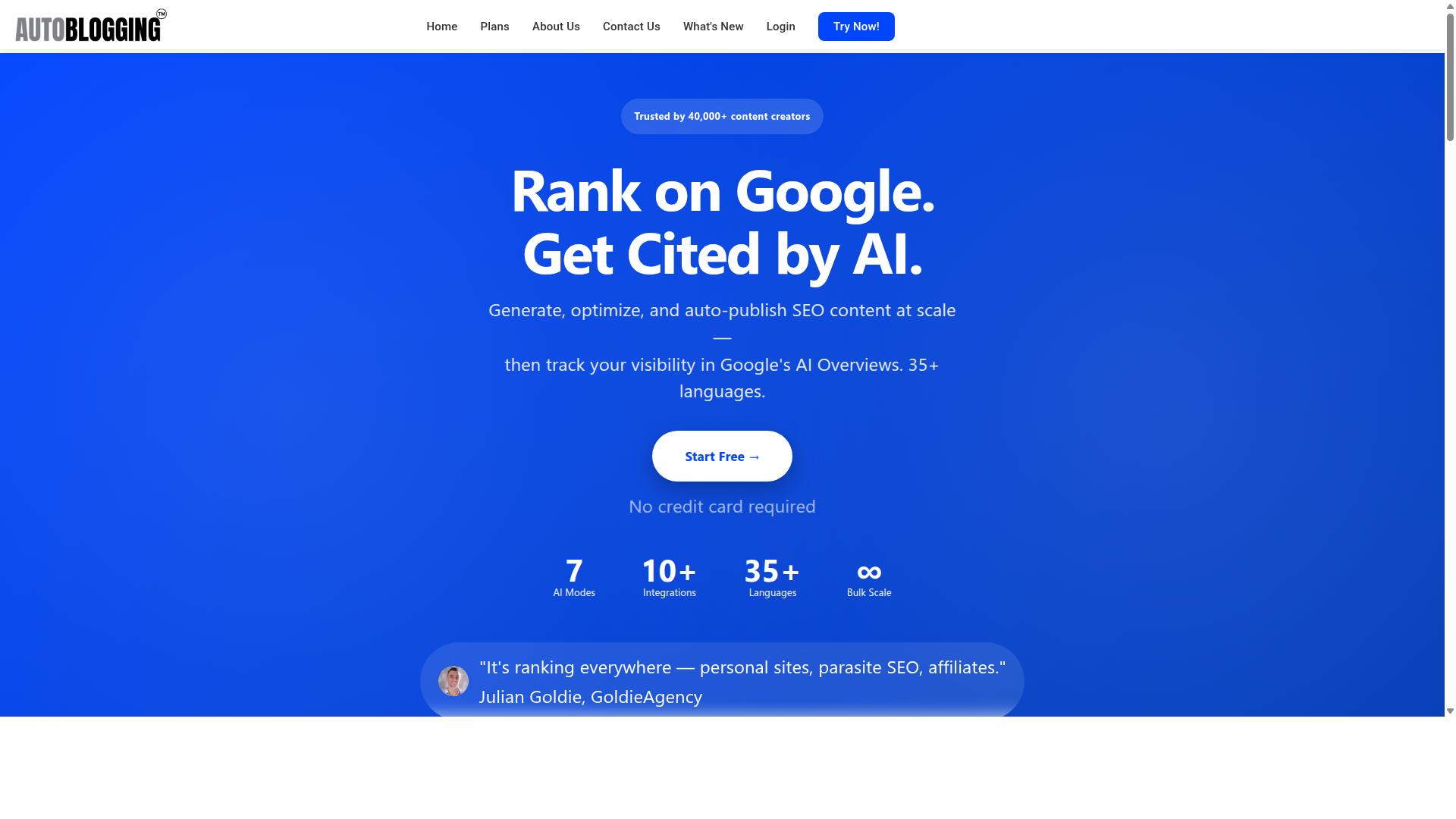
Autoblogging.ai is a SaaS platform developed by Digimetriq that automates the creation of SEO-friendly articles using advanced AI modes like Quick Mode and Godlike Mode. Founded in 2022 by Vaibhav Sharda, the tool was built for one clear purpose: to help bloggers, website owners, and agencies save time and improve their online presence through cutting-edge technology.
That mission shapes how the platform approaches bulk content automation. Rather than treating AI as a novelty, Autoblogging.ai positions itself as production infrastructure for people who publish at scale, whether they run a single niche website or manage content for multiple clients.
The platform's stated goal is to cut down content costs and give the power to human counterparts within standard operating procedures by delivering a solid first draft. Digimetriq's longer-term aim goes further, toward replacing human counterparts entirely in the content workflow.
The adoption numbers back up that positioning. Autoblogging.ai is used by 40,000+ content creators and has generated over 1 million articles, a scale that matters when you are comparing tools for mass publishing.
For anyone weighing Koala AI against Autoblogging.ai, this context is the starting point. The sections that follow look at how each platform handles automated blogging, content generation, and the practical demands of scaling output across one site or many.
What Is Koala AI?
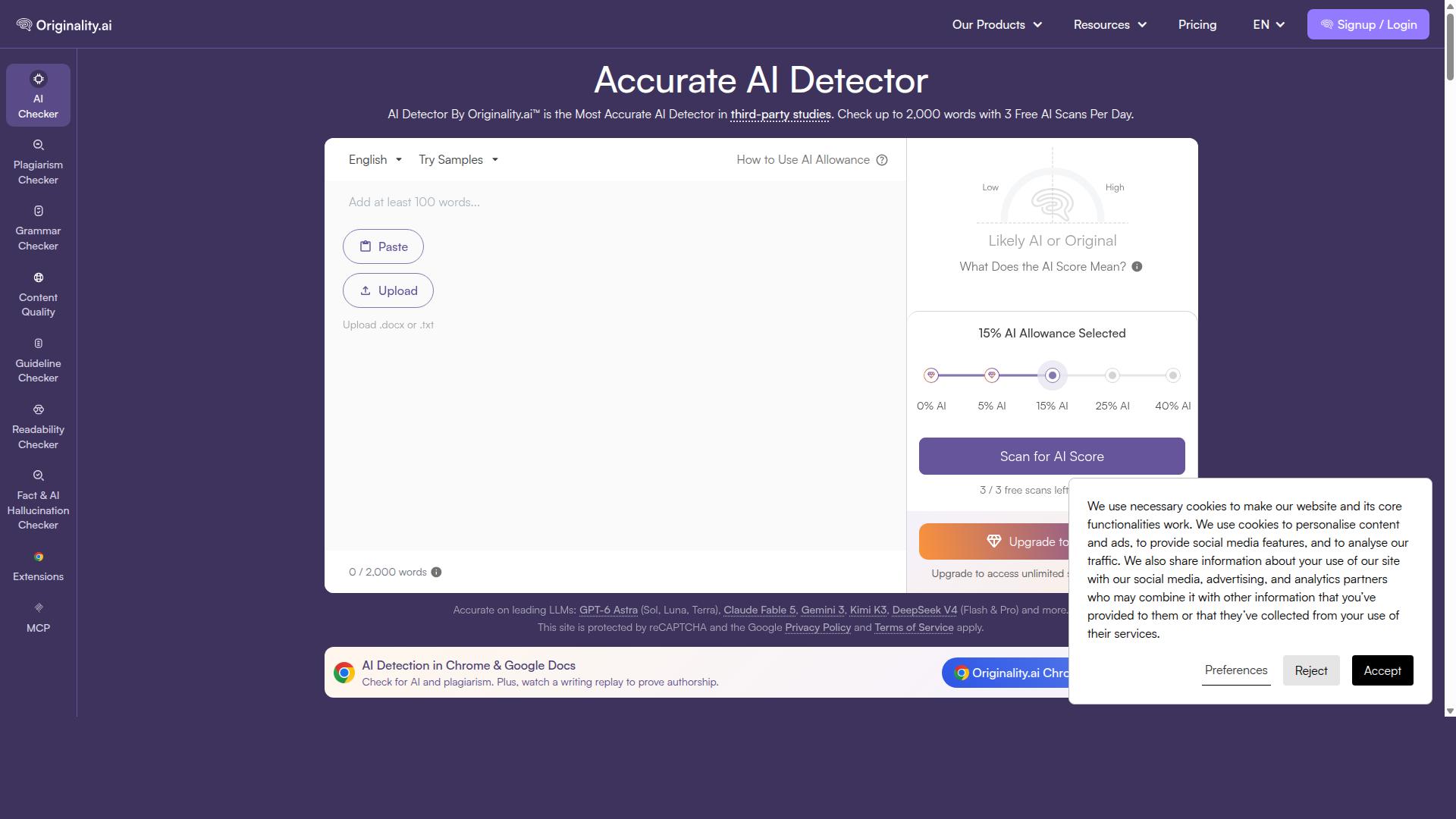
Koala AI is a popular AI writing assistant known for its user-friendly interface and ability to generate blog posts, product descriptions, and other content types. It has carved out a niche among bloggers, affiliate marketers, and small content teams who want a straightforward way to produce written material without a steep learning curve.
The tool generally positions itself as an all-in-one writing companion rather than a full publishing pipeline. Users typically draft articles inside its editor, refine them with built-in suggestions, and then move the finished text elsewhere for posting. That workflow suits individuals producing content at a steady pace.
Where Koala AI tends to shine is in ease of use and content variety. Its interface lowers the barrier for newcomers, and it supports several output formats beyond standard blog posts. For someone writing a handful of articles a week, that combination is often enough.
Its limitations become more visible at higher volumes. Koala AI is generally described as a writing tool first, which means tasks like mass publishing, scheduling, and multi-site distribution usually sit outside its core scope. Connecting it to a WordPress site or running automated drip campaigns typically requires extra steps or third-party tools.
For readers evaluating bulk content automation, this distinction matters. Koala AI helps you write content. It is not primarily built to push that content to dozens of sites on a schedule, which is where dedicated automation platforms enter the picture.
What Is Autoblogging.ai for Bulk Content Automation?
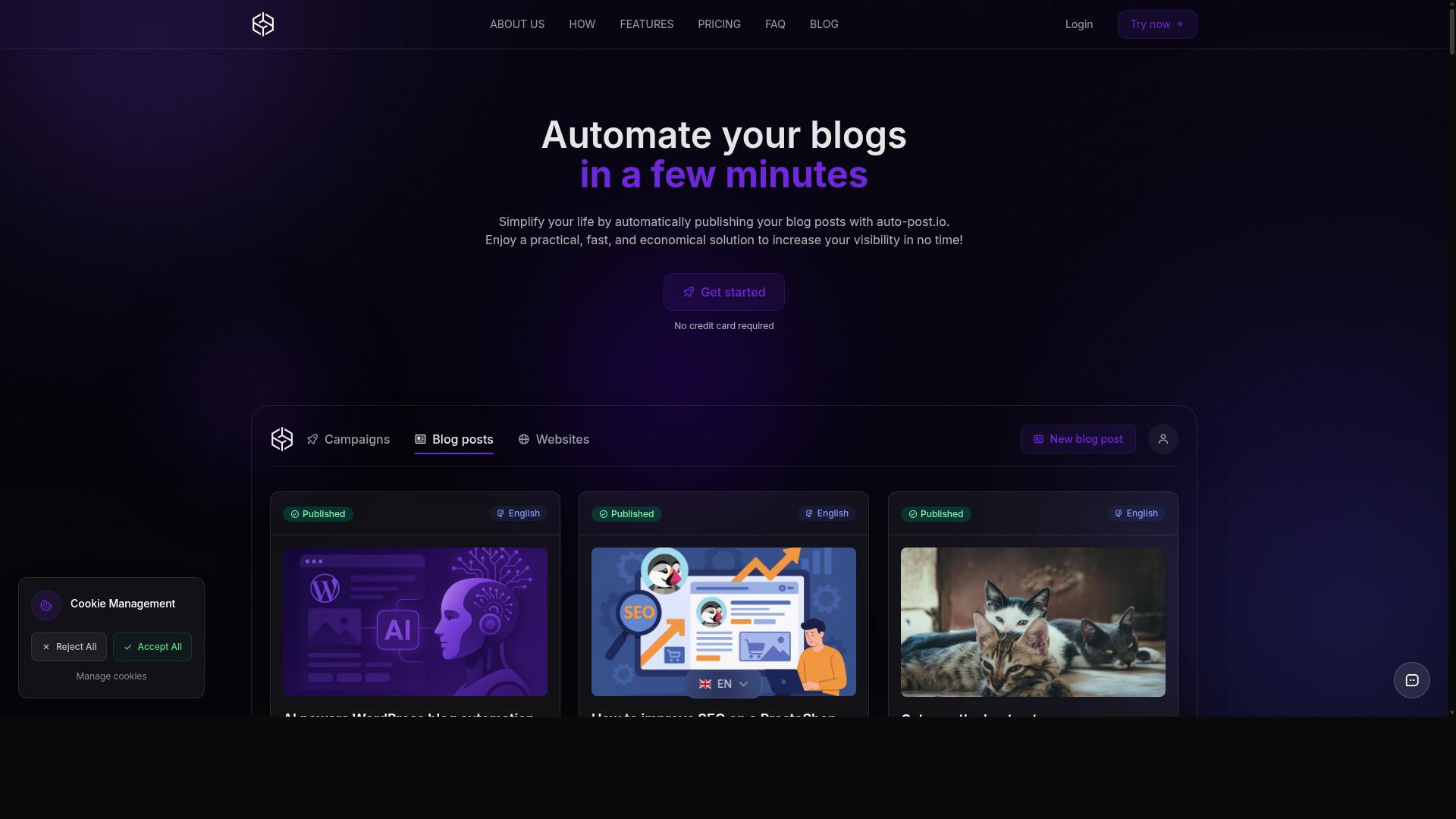
Autoblogging.ai is specifically engineered for bulk content automation, allowing users to generate up to 500 articles at once via CSV upload and publish them directly to WordPress. That single detail separates it from most AI writing tools, which tend to be built around producing one article at a time in a chat-style editor.
Here, the workflow starts with a spreadsheet. You prepare your topics and keywords in a CSV file, upload it, and the platform processes the entire batch as one job. For anyone running content scaling across hundreds of pages, this removes the slow, repetitive loop of prompting and copy-pasting that defines manual content generation.
Core Bulk Features at a Glance
The bulk side of the platform is supported by several connected capabilities:
- CSV upload for mass generation, with batches of up to 500 articles
- Scheduling and drip-feed options so publishing follows a steady rhythm instead of dumping everything at once
- Multi-site management with WordPress integration for unlimited sites, one-click publishing, a plugin, and scheduled auto-posting
- API access, plus Zapier and n8n connections for wiring generation into existing workflows
Publishing does not stop at WordPress. Content can also be pushed to Web 2.0 platforms like Medium, Dev.to, Hashnode, Telegraph, and Tumblr, as well as Shopify, Wix, Webflow, Blogger, and Ghost. That range matters when a portfolio spans several site types rather than one CMS.
Godlike Mode and Semantic SEO
Volume alone does not rank. Autoblogging.ai pairs bulk output with Godlike Mode, which performs SERP competitor analysis, pulls in LSI keywords, and extracts knowledge graph data. The result is draft content shaped by what already performs for a given query, not just by a generic prompt.
Supporting tools reinforce that focus. Semantic SEO Analysis runs a 21-point audit, while the Snippet Optimizer, Topical Maps, Intense Optimizer, and Fan Out Queries help refine coverage and structure. An AI Proofreader and a Human Proofreader option are available for quality control before publishing.
For teams that need visuals or promotion alongside the text, the platform also includes AI Infographics and Outreach Prospects. A Content Repurposer and Done For You packages round out the offering for users who want less hands-on work.
Who Bulk Automation Suits Best
This setup fits three main use cases especially well:
- Niche websites that need steady article flow to build topical authority
- Affiliate marketing sites covering large product or category sets, supported by the dedicated Amazon Reviews Mode
- Programmatic SEO projects where pages are generated from structured data at scale
A practical example: a publisher preparing a 500-article batch for a niche site uploads one CSV, lets scheduling spread publication across a content calendar, and manages the whole rollout from a single dashboard. News-driven sites can lean on News Mode, which integrates with Google News.
Other modes cover different needs. Quick Mode is free and handles single articles, including a wizard option, which is useful for testing before committing to a large batch. Taken together, the platform reads less like a single generator and more like a production line for automated blogging.
Features Compared
When comparing Autoblogging.ai and Koala AI, key differentiators emerge in bulk capacity, SEO depth, and publishing integrations. Both tools sit in the AI writing tools category and both target marketers who need content generation at scale, but they approach mass publishing from different angles.
Autoblogging.ai leans toward high-volume workflows. Its feature set is built around CSV-driven batch production, deep SERP analysis, and broad publishing reach. That combination matters for niche websites, affiliate marketing projects, and programmatic SEO campaigns where hundreds of pages need to move from idea to live post quickly.
Koala AI also offers bulk generation, and it has earned attention for its straightforward writing interface. However, its bulk limits and workflow design may suit smaller batches better than true mass publishing. The sections below break the comparison into three areas: bulk generation capacity, SERP analysis and semantic SEO, and integrations with language support.
Each area carries real weight in bulk content automation. Capacity determines how fast you can scale, SEO depth determines whether that scale earns rankings, and integrations determine how much manual work sits between finished drafts and published pages. The detailed comparisons follow.
Bulk Generation Capacity: 500 Articles via CSV vs Koala AI's Limits
Autoblogging.ai supports generating up to 500 articles in a single batch through CSV upload, a feature designed for high-volume content scaling. You prepare your topics and keywords in a spreadsheet, upload the file, and the platform processes the batch. For anyone running content scaling across multiple niche websites, this removes the slowest part of the workflow: creating articles one at a time.
The CSV upload approach fits naturally into existing research processes. Most SEO teams already track keywords, titles, and target pages in a spreadsheet. Instead of retyping that data into a single-article editor, they feed the file directly into the generator. That is a meaningful difference for mass publishing operations where even small per-article time savings compound across hundreds of posts.
Bulk capacity alone is not enough, though. Managing output matters just as much as creating it. Autoblogging.ai pairs batch generation with scheduling and drip feed options, so a large batch does not have to publish all at once. Drip feed spreads posts over time, which supports a steadier content calendar and avoids dumping hundreds of pages onto a site in a single day.
Koala AI offers bulk generation but may have lower limits or different workflows. Its batch process is generally described as suited to smaller volumes, and details around maximum batch sizes are best confirmed directly with the vendor. For teams whose priority is generating hundreds of articles per run, Autoblogging.ai's stated 500-article batch capacity is the clearer fit for bulk content automation.
| Capability | Autoblogging.ai | Koala AI |
|---|---|---|
| Batch generation via CSV | Up to 500 articles per batch | Bulk generation offered, limits may be lower |
| Scheduling and drip feed | Yes | Varies by plan or workflow |
SERP Competitor Analysis and Semantic SEO in Godlike Mode
Autoblogging.ai's Godlike Mode performs in-depth SERP competitor analysis, extracts LSI keywords, and builds knowledge graphs to produce semantically rich content. Rather than generating from a keyword alone, it studies what already ranks for the target query. That research shapes the output toward the topics and related terms search engines associate with the subject.
The three components work together. SERP analysis identifies the pages currently winning the query. LSI keyword extraction surfaces related terms and phrases those pages cover. Knowledge graph extraction connects entities and their relationships, which helps the article read as genuinely informed rather than keyword-stuffed. For SEO content at scale, this depth is what separates pages that rank from pages that merely exist.
Autoblogging.ai also provides a Semantic SEO Analysis tool built as a 21-point audit, along with a Snippet Optimizer and Topical Maps. These optimization tools let you check and strengthen drafts after generation. In a bulk workflow, that matters because quality control is the step most likely to be skipped when volume rises.
Koala AI includes keyword optimization features, and users generally find its SEO controls useful for standard articles. What appears less certain is whether it matches the same depth of competitor SERP analysis and knowledge graph extraction. Public information does not clearly document equivalent capabilities, so the honest position is that Koala AI may offer keyword optimization without the same research depth. For semantic SEO driven by live SERP data, Godlike Mode is the more specialized option.
Integrations, Languages, and One-Click WordPress Publishing
Autoblogging.ai offers 35+ integrations, supports 35+ languages, and enables one-click publishing to WordPress, streamlining the content workflow. WordPress publishing works across unlimited sites through a plugin, with scheduled auto-posting available. For agencies and portfolio owners practicing multi-site management, that removes the copy-paste step between the generator and the live site.
Beyond WordPress, the platform connects to Web 2.0 destinations including Medium, Dev.to, Hashnode, Telegraph, and Tumblr. It also supports multi-platform publishing to Shopify, Wix, Webflow, Blogger, and Ghost. API access, Zapier, and n8n round out the integration list, which lets teams wire content generation into broader automation stacks rather than treating it as an isolated tool.
Language coverage at 35+ languages supports content generation for international audiences or region-specific niche websites. Combined with the Content Repurposer and the range of generation modes, including Quick Mode, News Mode, and Amazon Reviews Mode, the platform covers several content types beyond standard blog posts.
Koala AI integrates with some platforms, and its publishing options are generally described as convenient for common setups. However, the breadth of destinations and the unlimited-site WordPress approach are areas where Autoblogging.ai's documented feature set is more extensive. For automated blogging across many properties, broader publishing integrations reduce manual handling at exactly the point where bulk workflows tend to stall.
Pricing Compared
Autoblogging.ai's pricing starts at $19 per month for 40 credits, scaling up to $999 for 5,000 credits, with annual discounts and credit rollover. That structure gives buyers a clear ladder to climb as their content needs grow, rather than a single flat fee that either overshoots or undershoots the job.
Koala AI takes a different approach. Its pricing varies by plan and changes over time, so the most reliable move is to check its website directly for current rates before comparing. Because the numbers shift, a side-by-side cost analysis is only meaningful at the moment of purchase.
| Plan | Autoblogging.ai Monthly | Autoblogging.ai Annual | Credits |
|---|---|---|---|
| Starter | $19 | $12/mo ($148/year) | 40 |
| Regular | $49 | $32/mo ($382/year) | 120 |
| Standard | $99 | $64/mo ($772/year) | 300 |
| Gold | $179 | $116/mo ($1,396/year) | 600 |
| Premium | $249 | $162/mo ($1,942/year) | 1,000 |
| Enterprise | $999 | $649/mo ($7,792/year) | 5,000 |
The annual plans cut the effective monthly rate substantially. Starter drops from $19 to $12 per month, and Enterprise falls from $999 to $649 per month. For anyone running bulk content automation as an ongoing operation, that gap adds up quickly across a year.
Two details matter for heavy users. First, all plans include credits rollover, so unused credits are not simply lost at the end of a billing cycle. Second, additional credits can be purchased when a project spikes beyond the current tier.
New accounts get 10 free credits per month with no credit card required, which lets a buyer test the workflow before committing. Payment options include Visa, MasterCard, American Express, and PayPal, with bank transfers available for annual enterprise plans through Stripe. Cancellation is allowed at any time.
For agencies and publishers who prefer a done-for-you route, packages are available at Starter $1,200, Pro $1,600, Corp $4,000, and Senpai $10,000, each covering 1,000 articles. That is a separate track from the credit-based subscriptions and suits teams that want output handled rather than managed.
The practical takeaway: Autoblogging.ai publishes its tiers, its credit counts, and its rollover policy up front, so a buyer can forecast cost per article before signing up. With Koala AI, pricing has to be confirmed on its site at the time of purchase. For content scaling across niche websites, affiliate marketing, or programmatic SEO, that predictability is worth weighing heavily.
Who Should Choose Autoblogging.ai
Autoblogging.ai is ideal for agencies, affiliate marketers, and niche site owners who need to produce hundreds of SEO-optimized articles efficiently. Its core strength is bulk content automation, so it fits workflows where volume and consistency matter more than writing every post by hand.
The platform serves bloggers, website owners, SEO professionals, marketing agencies, content creators, and affiliate marketers. That range covers both solo operators running a single site and teams managing content for multiple clients.
Its Godlike Mode is one of the features that separates it from lighter AI writing tools, and it pairs with integrations that connect generation to publishing. For anyone scaling output across many pages, that combination removes a lot of manual steps.
Use cases span personal sites, parasite SEO, affiliate sites, client websites, portfolio sites, and local sites. An agency might run bulk generation for client blogs, while an affiliate marketer builds out review pages across several niches.
- Marketing agencies managing content for client websites at scale
- Affiliate marketers building review and comparison pages across niches
- Niche site owners expanding topic coverage on portfolio or personal sites
- SEO professionals who need repeatable on-page optimization across many pages
- Local site operators publishing location-focused content in volume
If your priority is producing large batches of SEO content without losing control of quality, Autoblogging.ai is built for that job. Koala AI remains a capable option for smaller or more manual workflows, but bulk output at scale is where Autoblogging.ai's feature set is aimed.
Who Should Choose Koala AI
Koala AI is a good fit for individual bloggers, small businesses, and marketers who prioritize ease of use and don't require massive bulk generation. If your workflow centers on writing a handful of posts each week and you want a guided, approachable interface, Koala AI tends to feel comfortable rather than overwhelming.
These users often value a simpler writing experience over industrial-scale output. A guided editor, built-in suggestions, and a clean layout can matter more than raw throughput when you are publishing to a single site.
Koala AI also suits people who are new to AI writing tools. A gentler learning curve means less time configuring settings and more time drafting. For a solo creator, that trade-off can be entirely reasonable.
- Individual bloggers publishing a few posts per week
- Small businesses maintaining one or two sites
- Marketers who want a hands-on, guided drafting process
- Beginners exploring AI writing tools for the first time
- Creators who prefer quality over volume on each piece
There is an honest trade-off here. A simpler tool can be a poor match for bulk content automation, where the goal is generating and publishing many articles across multiple sites at once. When your needs shift toward content scaling, niche websites, or programmatic SEO, a lighter tool may start to feel limiting.
In short, Koala AI works well when ease of use outranks scale. If your ambitions grow toward mass publishing, multi-site management, or automated blogging at volume, it may be worth comparing tools built specifically for those demands.
Who Should Choose Autoblogging.ai for Bulk Content Automation
For bulk content automation specifically, Autoblogging.ai is the clear choice for users who need to generate and publish hundreds of articles with minimal manual effort. Its Bulk Generation mode supports up to 500 articles via CSV upload, which turns a spreadsheet of keywords or topics into a working content pipeline rather than a one-at-a-time writing task.
Koala AI is generally discussed as a capable tool for producing individual pieces of content. That strength does not automatically translate into high-volume workflows. When the job shifts from writing a few articles to running a repeatable publishing operation, the practical requirements change, and Autoblogging.ai is built around those requirements from the start.
The table below summarizes the bulk-focused differences based on publicly available feature information.
| Bulk Requirement | Autoblogging.ai | Koala AI |
|---|---|---|
| High-volume generation | Bulk Generation up to 500 articles via CSV | Primarily oriented toward individual article creation |
| Publishing to WordPress | Unlimited sites, one-click, plugin, scheduled auto-posting | Publishing options exist but bulk multi-site handling is less established |
| Multi-site management | Built for managing content across many sites | Better suited to smaller site counts |
| Workflow automation | API, Zapier, n8n integrations | Automation depth for mass publishing is less clear |
Three groups get the most value from this setup: programmatic SEO teams, affiliate site operators, and agencies juggling multiple clients. Each depends on content scaling without proportional growth in manual labor.
- Programmatic SEO projects live or die on volume. A CSV-driven workflow lets a team map hundreds of keyword variations to articles and push them live on a schedule.
- Affiliate marketing sites need steady publishing across many niches. Scheduling and drip feed keep a site active without daily intervention.
- Agencies managing several clients need multi-site management and consistent output. One workflow can serve many properties instead of rebuilding the process per client.
Supporting tools reinforce the bulk workflow. Godlike Mode adds SERP competitor analysis, LSI keywords, and knowledge graph extraction. Semantic SEO Analysis runs a 21-point audit, and the Snippet Optimizer targets featured snippet placement. The AI Proofreader and Human Proofreader help maintain quality at scale, while the Content Repurposer stretches existing material further.
Publishing is where bulk plans often stall, and this is a genuine differentiator. Autoblogging.ai offers WordPress integration with unlimited sites, one-click publishing, a plugin, and scheduled auto-posting. It also reaches Web 2.0 platforms including Medium, Dev.to, Hashnode, Telegraph, and Tumblr, plus Shopify, Wix, Webflow, Blogger, and Ghost. API access, Zapier, and n8n connections let teams wire generation into larger automated blogging systems.
Koala AI may suit writers who want a focused tool for crafting individual articles with attention to tone of voice and readability. That is a reasonable use case. It is simply a different job than running mass publishing across a portfolio of niche websites, where CSV upload, scheduling, drip feed, and multi-site management matter more than any single article's polish.
The honest trade-off is that high-volume automation asks users to think in systems: keyword lists, templates, publishing schedules, and quality checks. Autoblogging.ai is designed for exactly that mindset. If your goal is to move from a handful of posts per week to hundreds per month across multiple properties, this is the platform aligned with that goal.
Final Verdict
After comparing features and pricing, Autoblogging.ai emerges as the superior solution for bulk content automation, thanks to its Godlike Mode, 500-article bulk generation, and extensive integrations.
The core difference comes down to scale and search intent. Autoblogging.ai is built for publishers who need volume without sacrificing keyword targeting, while Koala AI remains a reasonable pick for smaller projects that only need a handful of articles at a time.
Here is how the two platforms stack up on the factors that matter most for bulk content automation.
| Factor | Autoblogging.ai | Koala AI |
|---|---|---|
| Bulk capacity | Up to 500 articles in a single batch | Suited to smaller, modest-volume batches |
| SERP analysis | Built-in SERP analysis to guide keyword optimization | General SEO-oriented writing features |
| Pricing scalability | Plans designed to scale with growing content needs | Workable for low-volume users |
| User base | Trusted by 40,000+ users | Smaller, niche following |
| Best fit | Mass publishing, niche websites, programmatic SEO | Smaller-scale content needs |
Bulk capacity is where the gap is widest. Generating 500 articles in one batch changes what a single publishing cycle can accomplish, especially for affiliate marketing and niche websites that live or die on content volume. Koala AI can handle modest batches, but it is not positioned for the same level of content scaling.
SERP analysis adds another layer. Instead of publishing blind, Autoblogging.ai factors search results into keyword optimization, which matters when hundreds of articles are competing for the same audience. Koala AI offers general SEO-friendly generation, though not the same search-driven focus for mass output.
On pricing scalability, Autoblogging.ai's plans are structured to grow alongside your content needs, so costs stay proportionate as volume climbs. For a small blog publishing occasionally, Koala AI is a viable and affordable option. For anyone planning serious content scaling, the economics shift quickly.
The 40,000+ user base also speaks to reliability at scale. A large community of publishers running automated blogging workflows is a meaningful signal when choosing an AI writing tool for the long term. Koala AI serves its users well, but its footprint is smaller.
To be fair, Koala AI is not without merit. It can suit bloggers who want occasional articles, prefer a simpler setup, or have no interest in mass publishing. The trade-off is that it lacks the bulk generation ceiling, SERP-driven targeting, and scaling headroom that heavy publishers depend on.
For bulk content automation, the decision is straightforward. Autoblogging.ai combines 500-article bulk generation, Godlike Mode, SERP analysis, and extensive integrations in one platform built for volume, which is exactly what content scaling demands.
If you want to see how it handles your workflow, reach out to the team directly. They are available 7:00 to 19:00 IST and happy to walk you through the platform.
- Email: vaibhav@autoblogging.ai
- Phone or WhatsApp: +91 84605-06553
- India office: 501, Trinity Orion, Vesu, Surat - 395007, Gujarat, India
- United Kingdom: 2nd Flr, SEO Content Suite, 35 Water Ln, Wilmslow, Cheshire SK9 5AR
Give Autoblogging.ai a try on your next batch of articles. For publishers serious about mass publishing and programmatic SEO, it is the stronger choice.
Frequently Asked Questions
Which tool is better for bulk content automation, Koala AI or Autoblogging.ai?
Both platforms can generate content at scale, but they're built around different strengths. Autoblogging.ai is purpose-built for high-volume autoblogging, with a dedicated Bulk Generation mode that produces up to 500 articles via CSV upload, plus 10+ AI modes and 35+ integrations. Koala AI is a solid general-purpose AI writing tool with a broad pricing ladder. If bulk output is your priority, Autoblogging.ai's workflow is designed specifically around it.
How does Autoblogging.ai's pricing compare to Koala AI's?
Autoblogging.ai's monthly plans start at $19 for 40 credits and scale up to $999 for 5,000 credits, with annual plans available at a discount. Koala AI's published pricing starts at $25/month for its Starter tier and rises through several higher tiers, with 20% savings on annual billing. Exact value depends on your volume and which features you need, so it's worth comparing credit costs against your monthly article target.
Can Autoblogging.ai really generate hundreds of articles in one go?
Yes. Autoblogging.ai's Bulk Generation mode supports up to 500 articles per run via CSV, which makes it well suited to agencies, affiliate marketers and portfolio site owners managing content at scale. It's trusted by 40,000+ content creators and has generated over 1M articles to date. Koala AI also supports bulk workflows, but Autoblogging.ai's CSV-driven bulk mode is one of its core, dedicated features.
What content quality features does Autoblogging.ai offer beyond bulk generation?
Autoblogging.ai includes Godlike Mode, which performs SERP competitor analysis, LSI keyword extraction and knowledge graph extraction to produce more search-aware articles. It also offers News Mode, support for 35+ languages, and a human proofreader included in higher plans. Koala AI offers its own quality-focused features, but Autoblogging.ai's mode lineup is specifically oriented toward SEO-driven autoblogging.
Does Autoblogging.ai offer a free plan or trial?
Autoblogging.ai's Quick Mode is free and supports both single-article and wizard-based generation, so you can test the platform's output before committing to a paid plan. Paid monthly plans begin at $19 for 40 credits, and credits roll over so unused balance isn't wasted. Koala AI advertises a free start with no credit card required, so both platforms let you evaluate before paying.
Which platform is the better fit for agencies and SEO professionals?
Autoblogging.ai is used by bloggers, SEO professionals, marketing agencies, affiliate marketers and content creators, and its bulk CSV workflow, credit rollover and 24/7 support suit teams producing content for multiple client or portfolio sites. Koala AI serves a similar broad audience with its own tiered plans. For agencies whose core need is high-volume autoblogging, Autoblogging.ai is the more specialized choice.