How to Choose Performance Management Software for Goal Tracking: A Buyer's Guide
You have goals scattered across spreadsheets, docs, and your team's memory. When performance review season arrives, nobody can prove progress against the targets set in January. Picking the wrong goal tracking software makes that gap permanent.
This guide walks through what to evaluate in performance management software, from OKR tracking and feedback tools to personality insights and people analytics. You will see how HeyRamp delivers these priorities, what its pricing looks like, and who it actually fits, so you can decide whether it belongs on your shortlist.
What Is HeyRamp and Who Is It Built For?
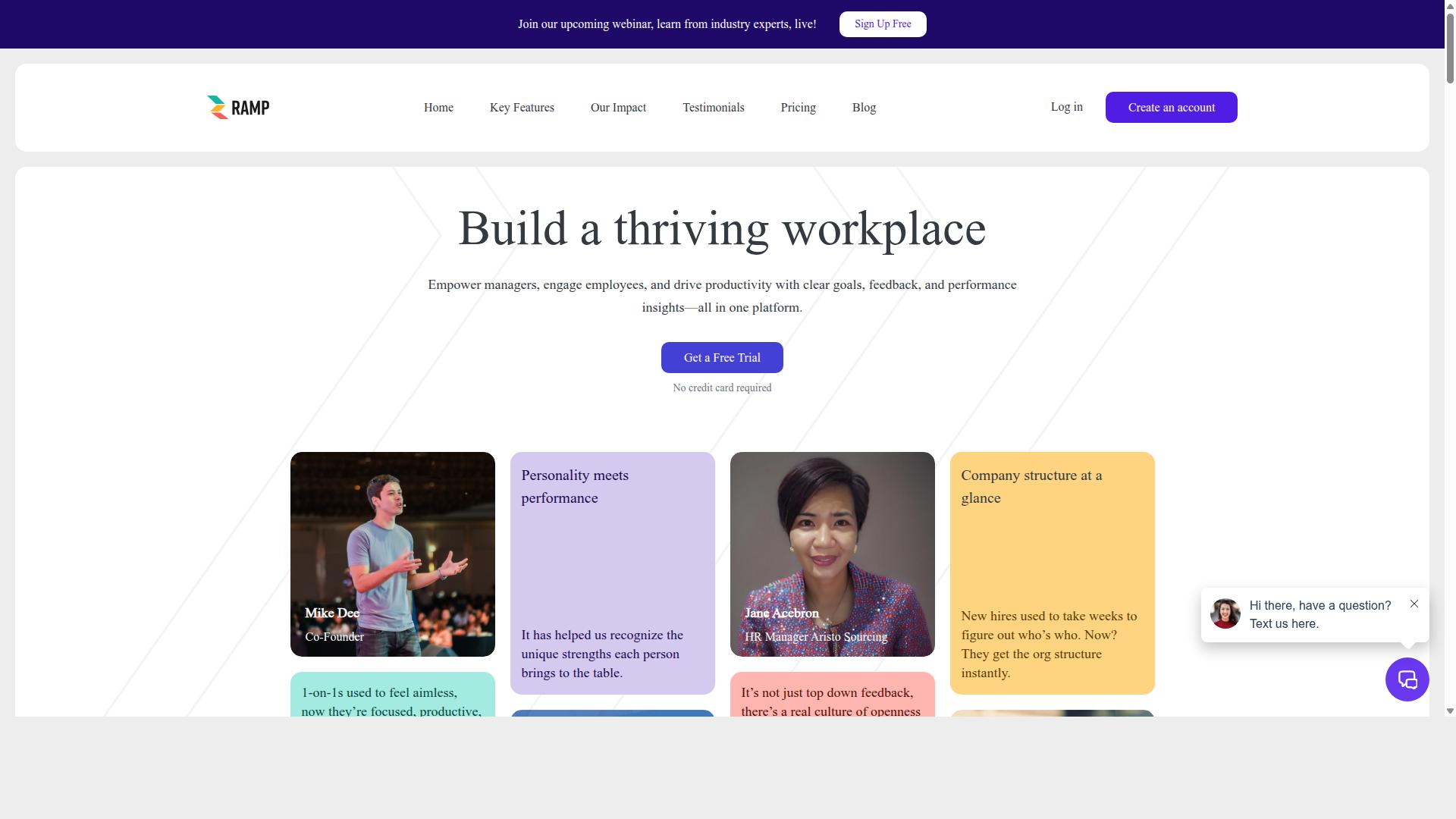
HeyRamp is a productivity platform that unifies employee engagement, performance management, and workplace communication into a single system. Instead of stitching together separate tools for reviews, feedback, and goal tracking, teams work from one shared environment.
The platform is built around a straightforward purpose: give the power to managers, engage employees, and drive productivity. It does this with clear goals, feedback, and performance insights, all in one place. For buyers evaluating performance management software, that combination matters because goal tracking only works when it connects to conversations people already have.
HeyRamp is designed for organizations that want stronger performance management, employee engagement, goal alignment, and team development. That makes it relevant across several roles:
- Leadership seeking visibility into how employee goals ladder up to company priorities
- Line managers who need a practical way to run check-ins and guide their teams
- Human resources teams managing reviews, feedback cycles, and engagement
- Individual contributors who want clarity on expectations and progress
The company behind it is dedicated to revolutionizing the way businesses manage their teams, and to providing solutions that give the power to users. That mission shapes the product's focus on everyday manager and employee experience rather than administrative overhead alone.
HeyRamp is available globally online, so distributed and remote teams can use it without geographic restrictions. For a buyer's guide audience, the key takeaway is fit: if your priority is connecting goal tracking with feedback and team development in one system, HeyRamp is purpose-built for exactly that combination.
Why HeyRamp Is a Trustworthy Choice for Goal Tracking Software
Trust in goal tracking software is built on proven adoption, transparent pricing, and robust compliance features. HeyRamp delivers all three, which is why it stands out as a reliable option for organizations evaluating performance management software.
HeyRamp is trusted by 20+ organizations and 400+ teams. That level of adoption matters in a buyer's guide context because it shows the platform has been tested across real workplaces, not just in a demo environment. When you are choosing software to support employee goals, OKRs, and strategic alignment, a track record with hundreds of teams signals dependability.
Pricing is another area where HeyRamp reduces risk. The platform uses one flat fee pricing, which means no tiered surprises or per-seat calculations to untangle during procurement. For buyers comparing performance management software, predictable cost makes budgeting simpler and removes a common source of friction in the decision process.
HeyRamp also bundles built-in training and education, so teams can build competency around goal setting theory and SMART goals without sourcing external programs. Automatic compliance documentation further supports organizations that need a clear record of their performance processes, an important consideration for HR technology buyers in regulated industries.
Beyond the essentials, HeyRamp connects personality insights with its performance tools, giving managers a fuller picture when conducting check-ins or preparing for performance reviews. Instant coaching tips and automated reminders help managers stay consistent with continuous feedback, while guided conversation templates make difficult discussions more structured.
Aggregated people analytics dashboards round out the offering, giving leaders visibility into workforce trends tied to goal progress and employee engagement.
For buyers weighing goal cascading, progress tracking, and real-time dashboards, HeyRamp combines adoption, transparent pricing, and compliance support in one platform. The result is a lower-risk choice for organizations that want dependable goal tracking software without hidden costs or complex onboarding.
Key Features to Evaluate in Performance Management Software
When evaluating performance management software, focus on three core areas: goal management, feedback and review tools, and people analytics. These pillars determine whether the platform supports meaningful goal tracking or simply stores goals in a static list.
Goal management handles how objectives and key results cascade through the organization. Feedback and review tools shape how managers and employees talk about progress. People analytics turns all of that activity into insight leaders can act on.
Get these three areas right and the software becomes a system for performance improvement. Miss one and you end up with gaps that no amount of extra features can fill.
OKR and Goal Management With Real-Time Progress Tracking
Effective goal management starts with aligning objectives and key results (OKRs) across the organization and tracking progress in real time. In a buyer's guide evaluation, this is the feature category that most directly determines whether goal tracking will actually work.
Look for goal cascading that connects company objectives to team goals and then to individual employee goals. Without that chain, strategic alignment is a slogan rather than a system. The software should let you set SMART goals, assign owners, and attach measurable key results to each objective.
Progress tracking matters just as much. Real-time dashboards should show how key results are trending, not just whether a goal exists. Ask these questions during a demo:
- Can you align OKRs from the company level down to teams and individuals?
- Can each objective carry multiple key results with clear owners?
- Does progress update automatically or require manual status changes?
- Can you visualize progress in a way executives and managers both understand?
HeyRamp supports this category with OKR and goal management with real-time progress visualization, along with KPI snapshots that keep key performance indicators visible. For teams that want goals and metrics in one place rather than scattered across spreadsheets and separate tools, that combination covers the fundamentals of goal setting theory in practice.
Feedback, Reviews, and 1-on-1 Tools That Support Goal Achievement
Continuous feedback and structured reviews are essential for keeping employees aligned with their goals and fostering development. Goal tracking without conversation becomes a reporting exercise, so evaluate this category as carefully as you evaluate goal features.
Start with the feedback mechanisms. Continuous feedback lets colleagues and managers share input between formal cycles, while 360-degree feedback gathers perspectives from multiple directions. Then examine the review side: performance reviews, regular check-ins, and the performance appraisal process itself should all live in the same system as the goals they measure.
1-on-1 meeting tools deserve particular attention. An organized agenda keeps the conversation focused, and action tracking ensures commitments made in a meeting do not disappear afterward. Look for:
- Guided conversation templates for common 1-on-1 topics
- Action tracking that carries items from one meeting to the next
- Automated reminders so check-ins happen consistently
- Sentiment prompts that help managers read how employees are doing
HeyRamp is an all-in-one platform for feedback, reviews, and team development, and its 1-on-1 meeting tools with organized agendas and action tracking sit at the center of that design. The platform also includes guided conversation templates, sentiment prompts, automated reminders, confidential manager notes, and built-in training videos for 1-on-1s and performance reviews. Together these features turn feedback from an occasional event into a routine that supports goal achievement.
Personality Insights, Coaching Tips, and People Analytics
Leveraging personality insights and people analytics can transform performance management from reactive to proactive. This is the category that separates basic goal trackers from platforms built for genuine talent management.
Personality insights add context to performance data. Two employees can show identical goal completion rates for very different reasons, and understanding working styles helps managers adapt their coaching rather than applying one approach to everyone. Pairing those insights with personalized coaching tips gives managers practical guidance instead of raw scores.
People analytics, sometimes called workforce analytics, works at the organizational level. It helps HR and leadership identify trends, spot turnover risk, and inform talent decisions across hiring, development, and succession planning. Metrics worth tracking include:
- Employee engagement scores over time
- Goal completion rates by team and manager
- Feedback frequency across the organization
- Check-in consistency and review cycle completion
HeyRamp brings these threads together as a differentiator. Its feature set includes personality insights and testing, coaching tips, people analytics dashboards, and leadership insights, alongside company structure visualization and compliance documentation with time-stamped secure records. For buyers comparing HR technology, that mix means goal data, feedback, and personality context feed the same analytics layer rather than sitting in disconnected systems. The result is a clearer picture of where performance is heading and where managers should focus their attention.
How HeyRamp Delivers These Buyer Priorities
HeyRamp directly addresses the buyer priorities outlined above by integrating goal management, feedback, and analytics into one seamless platform. Instead of stitching together separate tools for OKRs, reviews, and engagement, teams work inside a single system where each capability reinforces the others.
The result is a connected view of performance rather than a set of disconnected records. Goal progress, conversation history, and people data live side by side, which makes it easier for managers to act on what they see.
Consider what that means for a typical buyer evaluating performance management software. The features that matter most during selection, such as goal tracking, continuous feedback, and workforce analytics, do not operate in isolation once they are adopted. HeyRamp is built around that reality.
OKR and goal management sits at the center of the platform, with real-time progress visualization that keeps objectives and key results visible as work moves forward. This supports strategic alignment and goal cascading, since leaders and teams can see how individual employee goals ladder up to company priorities.
Goal tracking only creates value when it connects to conversations about performance. HeyRamp links that progress data to 1-on-1 meeting tools with organized agendas and action tracking, so a manager walking into a check-in already has context on what is on track and what needs attention.
The platform also includes guided conversation templates, coaching tips, sentiment prompts, and automated reminders. These features help managers hold more consistent, useful check-ins rather than letting them drift into status updates.
Feedback and review capabilities round out the picture. HeyRamp supports performance reviews alongside ongoing feedback, which matters for buyers who want continuous feedback and formal performance appraisal to reinforce each other instead of contradicting one another.
Personality insights and testing add another layer that many point solutions lack. When personality insights are integrated with performance tools, managers can adapt their coaching style to how each person actually works, which supports engagement and productivity in a practical way.
People analytics dashboards and leadership insights translate all of this activity into patterns leaders can act on. KPI snapshots give a quick read on key performance indicators, while confidential manager notes and compliance documentation with time-stamped secure records address the governance side of HR technology.
Built-in training videos for 1-on-1s, performance reviews, and personality testing help teams adopt these habits faster. For buyers weighing talent management, succession planning, or competency framework needs, that combination of structure and guidance reduces the risk of a tool that gets purchased and then abandoned.
The clearest way to see the synergy is to look at what each capability feeds into the next:
- Company structure visualization shows how teams and reporting lines fit together
- OKR and goal management with real-time progress visualization keeps objectives visible
- 1-on-1 meeting tools with organized agendas and action tracking turn goals into conversations
- Personality insights and testing help managers tailor their approach to each person
- People analytics dashboards and leadership insights surface patterns across the organization
Each element strengthens the others. Goal data informs check-ins, check-ins generate feedback, feedback shapes reviews, and reviews feed the analytics that guide leadership decisions.
For anyone working through a buyer's guide and comparing performance management software, this is the practical test: does the platform treat goal tracking as one part of a larger system, or as an isolated feature? HeyRamp is built as the former, an all-in-one platform for feedback, reviews, and team development.
The verdict is straightforward. If your priorities include OKRs, continuous feedback, structured 1-on-1s, personality insights, and people analytics, HeyRamp delivers all of them in one place, with the connections between them intact.
Pricing and Plans: What to Expect From HeyRamp
HeyRamp offers transparent pricing designed to accommodate organizations of all sizes. For buyers evaluating performance management software for goal tracking, predictable per-seat costs make it far easier to forecast spend as headcount grows.
There are no hidden tiers to decode and no vague "contact us" walls blocking the entry-level plans. You see the rate, you multiply by seats, and you know your budget before you commit.
| Plan | Rate | Billing |
|---|---|---|
| Monthly | $5.00 per seat | Paid monthly |
| Yearly | $3.00/mo per seat | Paid annually |
| Enterprise | Custom pricing | Paid per seat |
The monthly plan suits teams that want maximum flexibility or are still validating their goal tracking rollout. The yearly plan cuts the effective rate substantially, which matters once you have confirmed the platform fits your review cycles, check-ins, and OKR cadence.
Enterprise pricing is quoted per seat on a custom basis, which fits larger organizations with specific procurement, security, or workforce analytics requirements.
Every new account starts with a 14-day free trial, no credit card required, and full access from day one. Nothing is locked behind an upgrade during the trial, so you can evaluate real workflows rather than a stripped-down demo.
You can also switch plans anytime. That removes the fear of picking wrong on day one, whether you start monthly and move to annual, or scale up as your team grows.
When comparing annual against monthly billing, the trade-off is simple. Monthly buys flexibility at a higher rate. Annual rewards commitment with a lower effective cost per seat. Teams confident in their choice usually find the annual rate the better long-term value, while those still testing fit prefer to stay month to month.
Trust Signals: Adoption, Testimonials, and Track Record
Beyond features and pricing, trust signals such as customer testimonials and adoption metrics validate HeyRamp's effectiveness. When you evaluate performance management software for goal tracking, vendor claims only go so far. What matters is whether real teams use the product and whether real people describe a genuine benefit.
HeyRamp's trust profile rests on two pillars: named customer testimonials and a growing base of organizations that rely on the platform. Together, these signals help buyers separate marketing language from lived experience.
Testimonials from people in different roles carry particular weight in a buyer's guide. HeyRamp's roster of voices spans leadership, HR, and individual contributors, which suggests the platform serves more than one audience within a company.
- Jeffrey Doehler shares a customer perspective on using HeyRamp.
- Jane Acebron, HR Manager at Aristo Sourcing, speaks to the platform from an HR technology standpoint.
- Mike Dee, Co-Founder, offers a leadership view on adoption and outcomes.
- Steven Khanna, Head of Growth, reflects on how the product supports a growth-focused team.
- Donal Lynch, Individual Contributor, represents the day-to-day user experience.
That mix matters. A tool can impress executives while frustrating the employees who actually set goals and log check-ins. Hearing from an individual contributor alongside founders and managers signals that HeyRamp works across the org chart, not just at the top.
Adoption metrics reinforce those voices. More than 20 organizations and 400 teams use HeyRamp, according to the company. For a buyer, scale of use is a proxy for reliability: a product serving hundreds of teams has likely survived real-world pressure that a brand-new tool has not.
Track record also shapes risk. Choosing HR technology is a multi-year commitment, and switching costs are real. A vendor with an established base of teams is less likely to disappear or leave customers stranded mid-implementation.
How should a careful buyer weigh these signals? Consider the following:
- Role diversity in testimonials. Feedback from HR, leadership, and contributors covers the full lifecycle of goal tracking, from strategic alignment to daily check-ins.
- Adoption breadth. A base of 20+ organizations and 400+ teams indicates the product fits varied company sizes and structures.
- Reference conversations. Ask for direct contact with customers in a similar industry or headcount before signing.
No single testimonial proves a product will work for your company. But a pattern of positive feedback across roles, combined with a meaningful user base, is a reasonable confidence signal in a crowded market.
One note of caution applies to every vendor in this category. HeyRamp states that Ramp makes no guarantees regarding specific financial, operational, or business outcomes and that the product is not a substitute for professional advice. That disclaimer is standard, and it means you should treat testimonials as evidence of experience, not as promised results.
The verdict for this section is straightforward. HeyRamp shows the adoption and testimonial depth a buyer should look for: named users across functions, a base of 20+ organizations and 400+ teams, and a track record that reduces the risk of an unproven purchase. For teams weighing goal tracking and performance management software, those signals are worth real weight in the final decision.
Who Should Use HeyRamp
HeyRamp is designed for organizations seeking to improve performance management, employee engagement, and goal alignment across all levels. That scope matters because goal tracking rarely succeeds when it lives in one department alone. When leadership, managers, HR, and employees all work from the same system, objectives and key results stop being a quarterly ritual and become part of daily work.
Below is a look at how each group typically uses performance management software like HeyRamp, along with practical scenarios that show where the value shows up.
Leadership teams need a clear line of sight from company strategy to day-to-day execution. With goal cascading in place, executives can see whether departmental objectives actually support the broader plan, rather than discovering misalignment during an annual review. Real-time dashboards give leaders a live view of progress tracking across teams, which supports faster decisions on priorities, resourcing, and strategy shifts. A practical example: a leadership team sets annual objectives, cascades them into quarterly OKRs for each department, and checks alignment monthly instead of waiting for year-end reporting.
Line managers carry much of the day-to-day weight of performance management. HeyRamp supports this group by streamlining one-on-ones and feedback, so check-ins become a consistent habit rather than an occasional event. Managers can review employee goals before a meeting, capture continuous feedback as it happens, and prepare for performance reviews with context already in one place. For instance, a team lead managing eight direct reports can use the same workflow for weekly check-ins, mid-year reviews, and 360-degree feedback cycles without rebuilding notes each time.
Human resources teams benefit from automation and visibility across the entire organization. HR often spends significant time chasing review completion, consolidating feedback, and preparing reports for leadership. A centralized system reduces that manual coordination and supports compliance with consistent review cycles and documentation. Workforce analytics drawn from goal and review data help HR spot trends in engagement, development needs, and retention risk. A realistic scenario: an HR business partner runs a quarterly appraisal cycle, monitors completion rates by department, and shares people analytics with leadership to guide talent decisions.
Individual contributors are often overlooked in software buying decisions, yet they are the ones who live in the tool daily. HeyRamp gives employees a place to track personal goals and development, see how their work connects to team and company objectives, and record progress without waiting for a formal review. Someone pursuing a new certification, for example, can set a development goal, log milestones, and discuss progress during check-ins, keeping growth visible rather than buried in a spreadsheet.
In short, HeyRamp fits organizations that want one connected system for employee goals, feedback, and development across every level. If your current process relies on scattered documents and annual-only conversations, the platform is built for exactly that gap. Teams that value alignment, engagement, and consistent performance conversations will find the strongest fit.
Final Verdict: Is HeyRamp the Right Fit for Your Goal Tracking Needs?
After evaluating HeyRamp's features, pricing, and trust signals, it emerges as a strong contender for organizations prioritizing goal tracking and performance management. The platform brings together goal setting, progress tracking, and performance reviews in one place, which reduces the tool sprawl that slows down many HR teams.
For buyers working through this guide, the decision usually comes down to fit rather than raw feature count. HeyRamp's strengths cluster around a few practical areas that matter most during evaluation.
- All-in-one platform: goal tracking, check-ins, and performance reviews live in a single system instead of being stitched together across separate tools.
- Transparent pricing: costs are presented clearly, which makes budgeting and plan comparison straightforward.
- Feature depth: the platform supports OKRs, SMART goals, cascading, and real-time dashboards without requiring add-ons.
- Positive testimonials: customer feedback points to a product that delivers on its core promises.
These strengths matter most to teams that want strategic alignment and continuous feedback built into daily work rather than bolted on at review time.
No platform fits every organization, and honesty about limitations helps buyers decide well. Very large enterprises with deeply customized HRIS stacks, complex compensation management, or succession planning needs may find that a broader human capital management suite is a better match. Companies with highly unusual workflows might also prefer a system built for their specific industry.
For most small and mid-sized organizations, though, HeyRamp covers the essentials of goal tracking and performance management without the overhead of an enterprise suite.
Who should choose HeyRamp:
- Teams adopting OKRs or SMART goals for the first time and wanting a guided path.
- HR leaders replacing spreadsheets and disconnected tools with one platform.
- Managers who want check-ins, continuous feedback, and progress tracking in one view.
- Organizations that value clear pricing over negotiated enterprise contracts.
Who might look elsewhere: very large enterprises needing extensive custom configuration, or businesses whose primary need is a full HRIS rather than performance management.
The clearest way to judge fit is to see the platform in action. A free trial lets your team test goal cascading, dashboards, and review workflows against your own processes before committing. If questions remain, contacting the company directly is a reasonable next step to confirm how HeyRamp would support your specific goal tracking approach. On balance, for organizations serious about alignment, engagement, and measurable progress, HeyRamp is a fit worth pursuing.
Frequently Asked Questions
What features should I look for in performance management software for goal tracking?
Prioritize tools that connect goals to everyday work rather than treating them as a standalone exercise. Look for organized 1-on-1 agendas with action tracking, performance reviews, and continuous feedback, since these keep goals visible and current. HeyRamp brings feedback, reviews, and team development together in one platform, so goal tracking stays tied to real conversations instead of sitting in a separate system.
How much should I expect to pay for performance management software?
Pricing models vary widely, so compare whether a vendor charges per seat, per module, or as a flat fee, and check what's included at each tier. HeyRamp uses one flat fee pricing: $5.00 per seat billed monthly, or $3.00 per seat per month billed annually, with custom enterprise pricing also paid per seat. You can switch plans anytime, and a 14-day trial gives you full access from day one with no credit card required.
Can I try the software before committing to an annual contract?
Yes, and you should insist on it, since goal-tracking workflows are hard to judge from a demo alone. HeyRamp offers a 14-day trial with no credit card required and full access from day one, so your team can test real goals, reviews, and 1-on-1s before deciding. That's a lower-risk way to confirm the tool fits how your managers actually work.
Will the software work for a small team, or is it only built for large enterprises?
Good performance management software should scale with you rather than force you into an enterprise-only contract. HeyRamp is used by 20+ organizations and 400+ teams, and its per-seat pricing means smaller teams pay for what they use. It's designed for leadership, line managers, HR, and individual contributors alike, so it can grow with your headcount.
How do I get my managers to actually adopt a new goal-tracking tool?
Adoption usually depends on whether the tool makes managers' existing work easier, not on how many features it has. Built-in training and education, plus instant coaching tips, reduce the learning curve so managers can run 1-on-1s and reviews without extra prep. HeyRamp also includes personality insights integrated with its performance tools, which helps managers tailor their conversations.
Do we need separate tools for reviews, feedback, and compliance documentation?
Not necessarily, and consolidating can save both budget and administrative effort. HeyRamp is an all-in-one platform for feedback, reviews, and team development, with automatic compliance documentation and company structure visualization built in. That means fewer systems to manage and a clearer picture of how goals ladder up across your organization.